

Does your dog act like you’re speaking a foreign language when you give commands?
Most dog owners think their pup is just being stubborn or defiant when they ignore basic requests. But here’s the thing, your dog isn’t trying to drive you up the wall on purpose. They’re probably just as confused as you are frustrated.
That sinking feeling when your dog bolts toward another dog despite your frantic calls? The embarrassment when they jump on your dinner guests for the third time this week? The exhaustion from repeating “sit” fifteen times before they finally comply?
These moments can make you question if you’re cut out for dog ownership at all.
But what if the problem isn’t your dog’s attitude but it’s the mixed signals we accidentally send every day?
The truth is, most listening problems stem from unclear communication, not canine rebellion. Dogs crave consistency and clear direction.
In this guide, you’ll discover why traditional training methods often backfire and learn proven techniques that build genuine respect and trust.
Why Your Dog Ignores You
Here’s a reality check that might surprise you: your dog isn’t plotting against you during morning coffee. That selective hearing you’re convinced they have? It’s not spite, it’s confusion.
Most dogs labeled as “stubborn” are actually overwhelmed or unclear about what you want. Think about it from their perspective. One day you let them jump on the couch, the next day you’re upset about muddy paws on the cushions. Yesterday you laughed when they barked at the mailman, today you’re shushing them frantically during a work call.
We accidentally teach our dogs to tune us out through inconsistent responses. When “come here” sometimes means treats and praise, other times means bath time, and occasionally gets ignored entirely when we’re distracted, why would they rush over eagerly?
Dogs thrive on predictable patterns. When those patterns shift constantly, they learn to wait and see what mood you’re in before deciding if your command is worth following. That’s not defiance, that’s smart survival instincts.
Respect vs. Fear
Real respect from your dog looks different than you might expect. It’s not a cowering animal who obeys out of fear of punishment. True respect creates a dog who chooses to listen because they trust your leadership and know good things happen when they do.
Fear-based compliance might look impressive in the short term. Your dog stops jumping immediately when you yell. They drop that shoe when you storm over with a stern voice. But this approach creates anxiety, not understanding.
A fearful dog is always calculating whether the risk of punishment outweighs their desire to do something.We at Stellar Canine avoid this behavior at all costs.
Respectful listening, on the other hand, comes from a dog who genuinely wants to cooperate. They’ve learned that following your guidance leads to positive outcomes, not just avoiding negative ones.
This creates a confident, happy dog who listens because the relationship feels good, not because they’re walking on eggshells.
The emotional difference is huge. Fear creates tension in your relationship. Respect builds a partnership where your dog actively looks to you for direction because they trust your judgment.
Setting the Foundation for Dogs to Listen
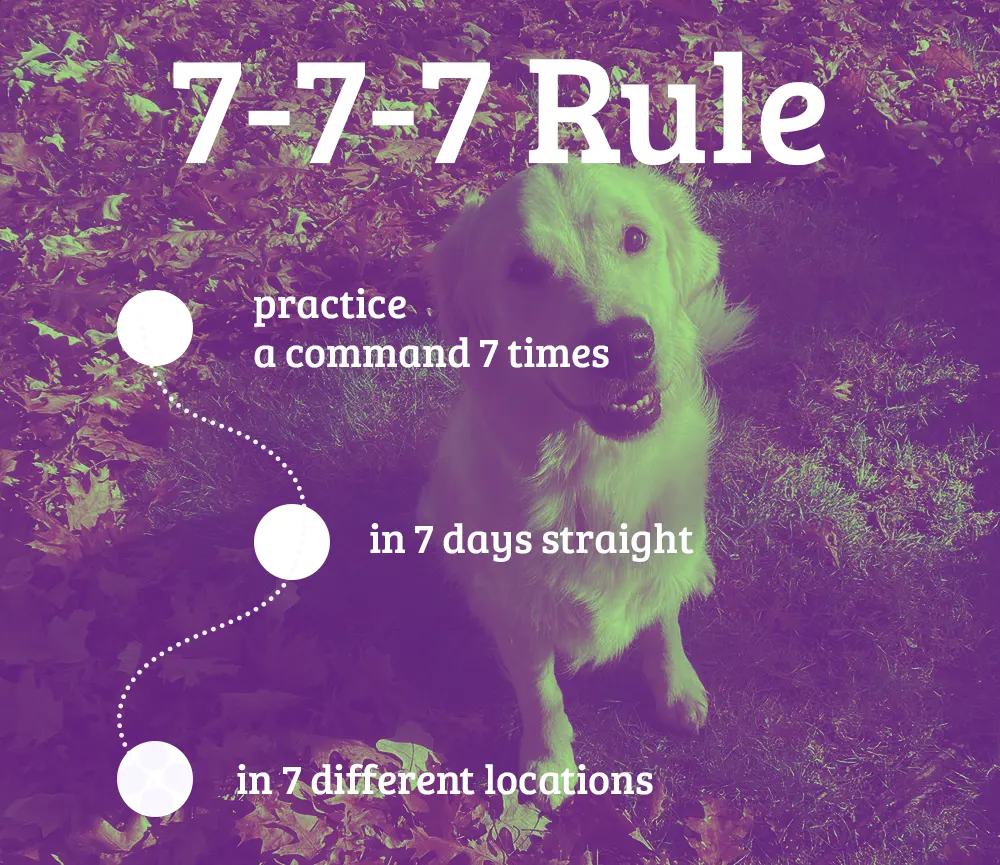
The 7-7-7 rule is simple but powerful: practice a command 7 times, in 7 different locations, for 7 days straight. This builds the consistency your dog’s brain craves while preventing “location-specific” obedience.
Most dogs learn to sit perfectly in the kitchen where you always practice, but act clueless at the park. That’s because they’ve learned “sit means sit in the kitchen near the treat jar,” not “sit means sit everywhere.” The 7-7-7 rule fixes this by creating multiple positive associations with each command.
Start with low-distraction environments and gradually increase difficulty. Day one might be your quiet living room. Day three could be the backyard with birds chirping. Day seven might be the front yard with neighborhood activity. Each successful repetition in a new location strengthens the command’s reliability.
Use this rule for daily routines too.
Practice “wait” at doorways, before meals, and during car rides. The more contexts where your dog successfully responds, the more automatic their good behavior becomes.
Clarity Over Correction
Mixed signals create chaos in your dog’s mind. When you say “down” but mean “get off the couch” instead of “lie down,” you’re speaking two different languages with the same word. Your dog isn’t being difficult, they’re genuinely confused.
Choose specific words for specific actions and stick to them religiously. “Off” means get off furniture or people. “Down” means lie down on the ground. “Wait” means pause where you are. “Stay” means don’t move until I release you. Everyone in your household needs to use the same words for the same behaviors.
At Stellar Canine we tell paw parents, your body language matters just as much as your words.
Dogs read our physical cues more than our verbal ones. If you’re saying “stay” while stepping backward and making encouraging gestures, you’re telling your dog to come toward you. Match your body language to your verbal command for crystal-clear communication.
Timing is everything. The moment your dog starts to comply not when they’ve fully completed the action, is when you mark the behavior with “yes” or a click. This tells them exactly which part of their behavior earned the reward.
The Power of Calm Energy

Yelling doesn’t make your words more important to your dog, it makes them harder to process. When you raise your voice, your dog’s stress levels spike, making it nearly impossible for them to think clearly and respond appropriately.
Dogs mirror our emotional state. If you’re frustrated and tense, they become anxious and reactive. If you’re calm and confident, they relax and become more receptive to learning. This isn’t mystical energy, it’s basic canine psychology.
Practice lowering your voice when you want your dog’s attention, not raising it. A calm, firm tone carries more authority than shouting ever will. Your dog will actually lean in to listen rather than shut down or become overstimulated.
Take three deep breaths before addressing unwanted behavior. This pause gives you time to respond thoughtfully instead of reacting emotionally. Your dog will notice the difference immediately and be more likely to cooperate with your calm leadership.
How to Get Your Dog to Listen Even in Chaos
The 1-2-3 method gives your dog clear escalating cues while teaching them that the first request is the one that counts.
Here’s how it works: give your command once in a normal voice, twice with slightly more firmness, and three times with gentle physical guidance if needed.
give your command once in a normal voice, twice with slightly more firmness, and three times with gentle physical guidance if needed
Most dogs learn to wait until the third repetition because we’ve accidentally trained them that the first two don’t really matter. The 1-2-3 method breaks this pattern by making each level slightly more compelling than the last, while never becoming harsh or intimidating.
For example, if your dog doesn’t come when called the first time, the second call might include their name and a more serious tone. The third level could involve walking toward them while repeating the command, making it clear that compliance isn’t optional.
The key is consistency. Every family member needs to follow the same progression. If someone gives up after one attempt or jumps straight to level three, you’re back to teaching your dog that commands are suggestions rather than expectations.
This method works because it respects your dog’s processing time while maintaining clear boundaries. Some dogs need a moment to shift their attention from what they’re doing to what you’re asking. The progressive approach gives them that moment while ensuring they understand you’re serious.
Building “Automatic” Responses
Automatic responses happen when your dog’s body reacts before their brain has time to debate. This comes from pairing verbal commands with consistent physical cues and practicing until the response becomes muscle memory.
Start by pairing your verbal command with a clear hand signal every single time. “Sit” always comes with your hand moving upward. “Down” always includes your hand moving toward the ground. “Come” always involves you patting your leg or opening your arms wide.
Practice in different environments to prevent “home-only obedience.” A dog who only sits in your kitchen hasn’t really learned to sit, they’ve learned a location-specific trick. Take your training to the park, the pet store, and friend’s houses to build true reliability.
The goal is for your dog to respond correctly even when they’re distracted, excited, or in an unfamiliar place. This level of reliability comes from hundreds of successful repetitions in various contexts, not from perfect performance in one controlled environment.
What to Do if Your Dog Isn’t Listening to You
When your dog suddenly stops responding to familiar commands, remember this essential handling tip: step back and assess the situation before escalating your efforts.
Are they overstimulated by their environment? Distracted by something more interesting than you? Or genuinely confused about what you’re asking?
The reset technique works wonders in these moments. Stop repeating the ignored command and instead ask for something simple that you know your dog will do successfully. “Touch” your hand, “sit,” or even just making eye contact. Once they comply with the easy request, praise them and then try your original command again.
This approach works because it breaks the cycle of frustration and gets your dog back into a cooperative mindset. Instead of escalating into a battle of wills, you’re reminding both of you that working together feels good.
Sometimes the issue is that you’ve accidentally poisoned a command by repeating it too many times without follow-through. If “come” has become background noise because you say it fifty times during every walk, take a break from that word and use “here” or “this way” instead while you rebuild the command’s value.
How to Punish a Dog for Chewing or Biting
Chewing and biting are natural dog behaviors that need to be redirected, not eliminated. Punishment often makes these behaviors worse by increasing anxiety and frustration, two emotions that make dogs more likely to use their mouths inappropriately.
For inappropriate chewing, immediately remove the forbidden item without drama and replace it with an appropriate chew toy.
The moment your dog’s mouth touches the right item, praise enthusiastically. You’re teaching them that good things happen when they make smart choices about what to chew.
Puppy biting requires a different approach. When those needle teeth touch human skin, immediately stop all interaction and walk away. No scolding, no pushing them away, no dramatic reactions. Just become boring and unavailable. This teaches them that biting makes fun humans disappear.
If the biting is more serious or involves resource guarding, professional help is essential. These behaviors can escalate quickly and require specialized techniques to address safely. Don’t try to tough it out or hope it will resolve on its own.
Making “No” Mean Something

Most dogs hear “no” so frequently that it becomes meaningless background noise. To make this word powerful again, you need to use it sparingly and always follow through with action.
Reserve “no” for behaviors that need to stop immediately, not for every minor infraction throughout the day. If you find yourself saying it more than a few times per day, you’re probably overusing it and diluting its impact.
When you do say “no,” immediately redirect your dog to an appropriate behavior and reward them for making the right choice. “No” should be the beginning of guidance, not the end of interaction. This teaches your dog that “no” means “stop what you’re doing and pay attention for better instructions.”
The tone matters more than volume. A firm, calm “no” carries more weight than a shouted one. Your dog should understand that this word means business without becoming fearful or anxious about hearing it.
Train Dogs for Real-Life, Not Just Commands
Real-world obedience happens in doorways, during meal preparation, and on busy sidewalks, not just during formal training sessions. Use everyday situations as opportunities to reinforce good listening skills rather than treating training as a separate activity.
Doorway manners are perfect for this. Before opening any door, ask your dog to sit and wait. They don’t get to go through until you give permission. This simple routine reinforces your leadership role dozens of times per day without feeling like formal training.
Meal times offer another natural training opportunity. Your dog learns to sit calmly while you prepare their food, wait for permission before eating, and understand that good things come from patience and self-control. These lessons transfer to every other area of their life.
Walking becomes training when you randomly ask for sits at crosswalks, practice recalls in safe areas, and reward your dog for checking in with you voluntarily. These real-world applications are more valuable than perfect performance in your living room.
Stellar Canine’s training philosophy centers on building genuine partnerships between dogs and their families through clear communication, consistent expectations, and positive reinforcement.
This approach creates lasting behavioral changes because it addresses the root causes of listening problems rather than just managing symptoms.
The structured training programs focus on teaching both dogs and owners how to communicate effectively with each other. Dogs learn what’s expected of them in various situations, while owners learn how to give clear, consistent cues that their dogs can easily understand and follow.
This method works because it builds confidence. Dogs become more secure when they understand the rules and know that following them leads to good outcomes. Owners become more confident when they have reliable tools for communicating with their dogs in any situation.
Your Path to a Dog Who Listens Anywhere
The unconventional truth about getting your dog to listen isn’t about being louder, stricter, or more dominant. It’s about becoming clearer, more consistent, and more trustworthy. When you focus on building understanding rather than demanding compliance, you create a dog who chooses to listen because the relationship feels good.
Calm leadership, crystal-clear communication, and trust-building exercises transform even the most “stubborn” dogs into eager partners. These aren’t quick fixes, they’re fundamental shifts in how you and your dog relate to each other that create lasting change.
For personalized guidance that makes listening second nature for your dog, Stellar Canine offers comprehensive training programs designed to build the strong foundation every great dog-owner relationship needs. Their approach focuses on creating genuine partnerships that work in real-world situations, not just perfect performance in controlled environments.
Frequently Asked Questions
Why does my dog ignore me when I call them?
It’s rarely defiance. Dogs typically ignore commands due to confusion from inconsistent training. If “come here” sometimes means fun and sometimes means bath time, your dog learns to be cautious. They thrive on predictable patterns and clear communication, which is often accidentally undermined by mixed signals from us.
What's the difference between a dog that obeys out of respect vs. fear?
A respectful dog listens because they trust your leadership and have learned that cooperation leads to positive outcomes. A fearful dog obeys to avoid punishment, which creates anxiety and can damage your relationship. True, lasting obedience is built on a partnership of trust, not intimidation.
My dog listens at home but not at the park. Why is that?
This is called “location-specific obedience.” Your dog has learned that “sit” means “sit in the kitchen,” not “sit everywhere.” To fix this, you need to practice commands in multiple, gradually more distracting environments to build a reliable, automatic response.
What is the 7-7-7 rule in dog training?
The 7-7-7 rule is a powerful technique for building consistency. You practice a command 7 times, in 7 different locations, for 7 days in a row. This prevents your dog from associating the command with only one place and strengthens their understanding no matter the environment.
How can I stop my dog from jumping on people?
The key is clarity and consistency. Use a specific command like “Off” (for getting off people/furniture) and ensure everyone in your household uses it. Reward your dog with attention *only* when all four paws are on the floor. Inconsistency, where jumping is sometimes allowed and sometimes punished, is the root cause of this behavior.
Is it okay to yell at my dog when they don't listen?
No. Yelling increases your dog’s stress levels, making it harder for them to think clearly and respond appropriately. Dogs mirror our energy; a calm, firm tone is far more effective and carries more authority than shouting. Calm energy leads to a calmer, more receptive dog.
What should I do when my dog completely ignores a command they know?
Use the “reset” technique. Stop repeating the ignored command and instead ask for a simple, known behavior like “sit” or “touch.” Praise them for complying to break the cycle of frustration and get them back into a cooperative mindset. Then, you can retry the original command.
How can I stop my dog from chewing on furniture or inappropriate items?
Redirect, don’t punish. Immediately and calmly remove the forbidden item and replace it with an appropriate chew toy. The moment your dog chews the correct toy, praise them enthusiastically. This teaches them what items are “theirs” to chew.
Why does the word "no" not work with my dog?
“No” often becomes meaningless background noise because it’s overused. To make it powerful, use it sparingly and always follow it with redirection to a positive behavior. For example, say “no” for chewing a shoe, then immediately give them a chew toy and praise them for chewing that instead.
What is the 1-2-3 method for dog training?
This method teaches your dog that the first command is the one that counts. Give the command once in a normal voice. If they don’t comply, repeat it with slightly more firmness. If needed, a third repetition includes gentle physical guidance. This breaks the habit of your dog waiting for multiple repeats before listening.
How can I train my dog for real-life situations, not just practice sessions?
Integrate training into daily routines. Practice “wait” at every doorway. Ask for a “sit” before mealtimes. Use your walks to practice random recalls and check-ins. This reinforces your leadership and their listening skills in the chaotic, real-world contexts where it matters most.
0 Comments